
This time of year, we tend to focus on a lot of male-centric mythologies. It’s not surprising really, the Solstice is nearly upon us and the return of the dying sun is forefront in our minds, and thanks to our still predominantly patriarchal society the boys tend to get the plum jobs. In the next few weeks it is likely you will hear of Odin whose eyes were said to be the Sun and the Moon, of Llew Llaw Gyffes grandson of Beli Mawr (the sun himself), Mithras and the Holly King. All of them either literally or figuratively light bringers, but it doesn’t take too much digging before you start coming across something that is mostly ignored in modern Paganism, the female light bringers. This is a subject for which I have a great fondness and love. Deities, holy women and honored ancestors, such as Hekate Phosphorus, Diana Lucifera, and most apt for this time of year the Disir and St Lucia (or St Lucy) all rocking the light and influencing humanity as only women know how.

St Lucy (Niccolo de Segna – Walters Art Museum)
The Feast of St Lucy is on the 13th of December, which prior to the change from the old Julian to the Gregorian calendar would have fallen approximately on the Winter Solstice. In Scandinavian countries St Lucy is still venerated on Jol/Jul with young girls dressing in pure white, their dresses adorned by a red sash and a crown of candles upon their heads. She is quite an interesting Saint in that she is both a very devout woman of Christ and potentially also a Witch. There are numerous folkloric tales about her, and these are region specific, but the essence of her story is that she was the only female child of a rich merchant family in Syracuse Italy. As a young child she travelled with her ailing mother to a shrine dedicated to St Agatha to pray for healing. St Agatha it is said performed a great miracle of healing which led to the instant conversion of the young Lucy to Christianity. But there was a slight problem, as was common in that time Lucy had been betrothed to a young man whose family was Pagan.
During the intervening years between Lucy’s conversion and her final Martyrdom it is said that Lucy persuaded her parents to give her the money reserved for her dowry so that she could spend it on alms for the poor, particularly those persecuted Christians who were at the time living as outcasts in the catacombs of the city. She traversed the dark tunnels with food and blankets loaded in her arms, her way lit by a crown of candles which she placed upon her head. Eventually her suitor came a calling and Lucy rejected him, claiming a life of virginal chastity dedicated to God. Outraged (and also probably miffed at the loss of the dowry more than anything else) the young man appealed to the city governor claiming the girl to be a Witch, something it seems that the Governor chose to believe. What followed is a sorry tale of abuse. Lucy is first taken to a Brothel to be defiled, but the soldiers tasked with escorting her cannot move her, even when they tie her to oxen and try and drag her. Next her eyes were gouged from her head, although in some tales these either regrew in their sockets or more alarmingly on the palms of her hands and finally they tried to burn her at the stake but no fire could be kindled. Eventually she was stabbed and died.
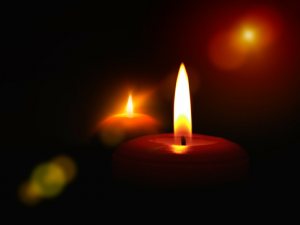
St Lucy has now become the Patron Saint of the Blind and is often prayed to or included in folk magic to heal afflictions related to the eyes including the effects of the ‘evil eye’. But there are some other magickal connections, Judika Illes[1] claims that in Austria the term “Lucy’s light” is another name for having psychic abilities and that in Hungary St Lucy’s eve is considered the time most propitious for performing acts of divination. As a cartomancer St Lucy is to me someone who can bring me clarity in my psychic works, allowing my deep vision to grow and develop, and it is for this that I venerate her at this time of year. A simple candle is all it takes, which I anoint with Star Anise and burn for a short while every night between the 13th and Christmas Eve saying a short spell as I light the candle.
“Dear St Lucy, bringer of light,
protect me through the darkest nights,
Bring forth my powers of second sight,”
[1] Encyclopaedia of Mystics, Saints and Sages (2011) Harper Collins
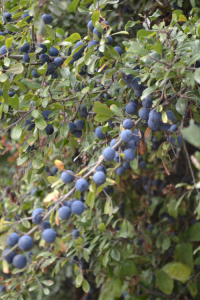
 And Blackthorn isn’t the only one. Scarlet Pimpernel works with me often in the summer months. I remember being enchanted when I saw these tiny delicate orangey flowers with a deep crimson centre. So petite it’s easy to miss them, it foretells of good times and bad. Once known as “Old Man’s Weather vane” its little flowers close in foul weather, Ive come to realise that this little plant spirit most often reveals itself to me when there is a promise of good things to come. Turning up unexpectedly in unlikely locations on a memorable day, I always take note of what Pimpernel has to say.
 It’s not totally necessary to understand its medicinal purpose or the folklore associated with it the plant, but I do find that it helps to understand the nature of what this “Shining One” is trying to say or it will suddenly make that initial connection easy. Currently my latest stalker plant is Black Nightshade. I came across a patch whilst playing a scavenger hunt in central London some weeks back and its been stalking me ever since, appearing in places I’ve walked and worked for years and I know I have never noticed this plant before. Its season is nearly over, but still I am finding it in flower in all sorts of places so I always stop and acknowledge it. Gently touch a flower or leaf and ponder why it is that I am only now noticing its presence. I can’t wait to find out what this little creature has to teach me about the Otherworld and myself.
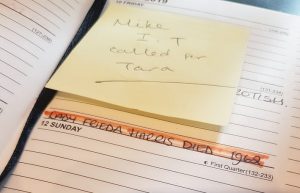 Without Gerald Brosseau Gardner, Philip Peter Ross Nichols (who I have recently discovered went to school in the same village I grew up in) or Orrell Alexander Carter (Alex Sanders) I would not have the religious and philosophical view that I have. They are another form of ancestor. And I also venerate them accordingly. As a result my personal diary doesn’t just contain the important dates relating to family and friends it also lists the birth and death dates of other important people. This week we have the anniversary of the death of Helena Blavatsky and Frieda, Lady Harris. Both movers and shakers in the Occult world in the last 150 years.
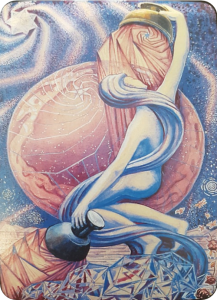 She was obviously a deeply loyal woman, she continued to care for Crowley supporting him both physically and financially right up until the end. She used her connections to promote gallery exhibitions of the original artwork for the deck. Helped finance the first run of 200 decks, and as a woman of means even paid Crowley an allowance to allow him to pursue his work in the Occult. And when his body (and many friends) failed him she provided nursing care. Finally she then gifted the original artwork to Crowley’s secretary Gerald Yorke before moving to India to live out her days.
 Ive just spent a lovely half hour walking my mothers dog. We wandered down to the pebbly beach and I collected hagstones, an item of great worth in my work with the fae. It’s an amazing beach, it is probably one of the most bountiful in its provision of holed and unusual stones that I have ever come across. Just a few minutes will yield a pocket full of stones. Most of which I return at the end of my stay. Although sometimes, just sometimes the odd one makes it way permanently into my life. It’s a very special place, its seen me snuggled under a duvet watching the stars with what was then my soon to be husband. It comforted me as I howled at the moon whilst grieving the loss of my father. It welcomed my small daughter summer after summer, watching her grow into a strong and independent woman. In short, it is personally one of the most sacred places in the world as far as I am concerned.